You’re Not a Partner, You’re a Hostage: The Real Cost of Vendor Lock-In
Sean Mentore
4 min read
If your core system is hard-coded to a vendor-specific feed, you are not a partner. You are a hostage.
I have worked in financial data infrastructure for twenty years. In that time, I have watched the same dynamic play out at institution after institution. A vendor promises partnership. They deliver rigidity. And the institution stays, because leaving is more expensive than paying.
The Hostage Dynamic
It starts subtly. The vendor’s feed has a specific schema. Your systems are built to that schema. Your ETL maps to their field names. Your calculation engines reference their data types. Your reporting systems assume their conventions.
Over time, your entire infrastructure becomes an extension of the vendor’s architecture.
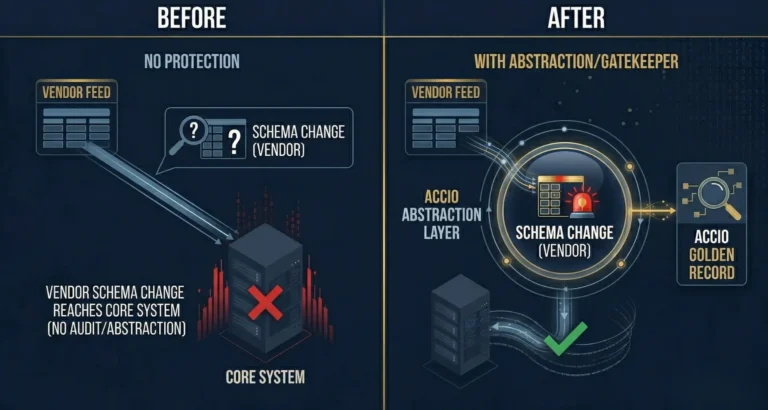
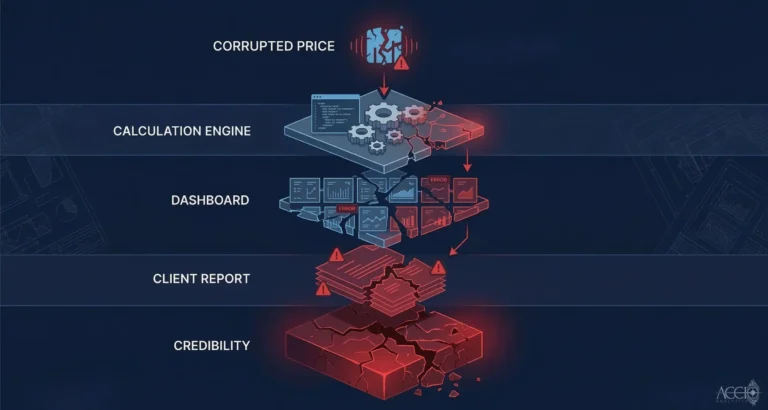
Then the vendor changes something. A schema update. A field rename. A new data point added to the feed. They communicate this approximately never. Nine times out of ten, your team finds out when the ETL fails or, worse, when it loads the wrong data silently.
The vendor’s position is consistent: this is how our system works. Take it or leave it.
The cost is not just the license fee. It is the nickel-and-diming at renewal. The customization requests that get rejected because they are not on the vendor’s roadmap. The pricing increases that arrive with the unspoken message: where else are you going to go?
A joint study by FINOS and the Linux Foundation found that 79% of financial services firms now use open-source solutions specifically to reduce dependency on individual providers (FINOS/Linux Foundation). That number tells you everything about how the industry feels about vendor lock-in.
What Switching Actually Costs
When a Tier 2 bank decides to switch data vendors, here is what actually happens. They are switching not because they want to. They are switching because the cost has become astronomical, or because new leadership is mandating a change.
Step one: schema mapping. The old system to the new system. Every field, every data type, every relationship. This alone takes weeks because the documentation for the old system is incomplete or missing. The people who built the original implementation have moved on. The institutional knowledge went with them.
Step two: the edge cases. One database holds 3 decimal places. The new one holds 13. You round up, and now your calculations are off. A fraction of a cent per position, multiplied across thousands of holdings. Country codes, currency codes, instrument identifiers that were standard in one system are wrong in another.
Step three: the undocumented dependencies. Code that holds the system together with a comment that says “do not touch this.” Business logic that was never documented. Workarounds that became permanent. Every institution has them. Nobody knows they are there until a migration forces them into the open.
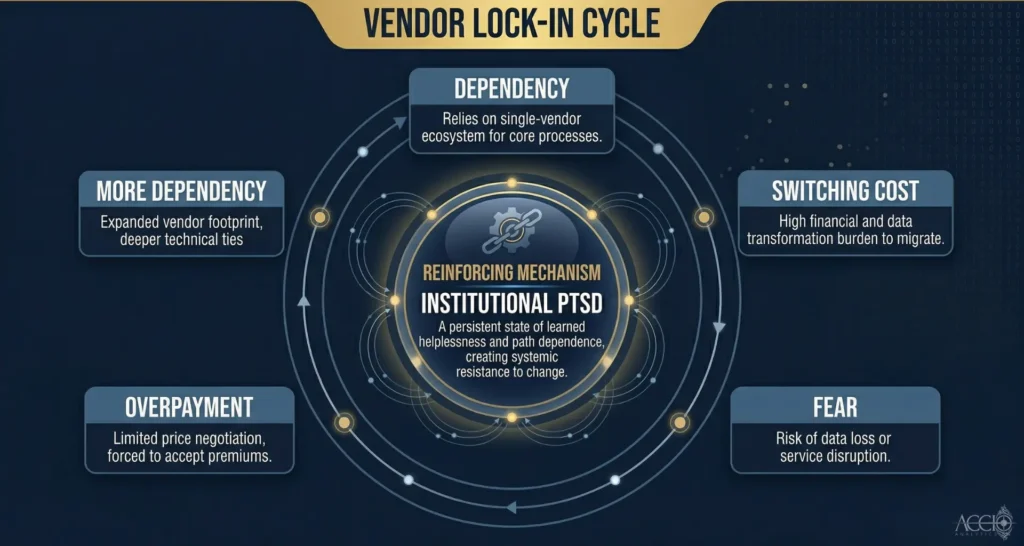
The real switching cost is not the implementation fee. It is the risk. The institutional memory of the last migration that went wrong. The nine months that became eighteen. The weekend of data that was lost. The three weeks of mismatched numbers.
I call this institutional PTSD. It is the reason bad vendors keep their contracts.
The Abstraction Alternative
The cure is not switching vendors more carefully. It is decoupling your core system from any single vendor.
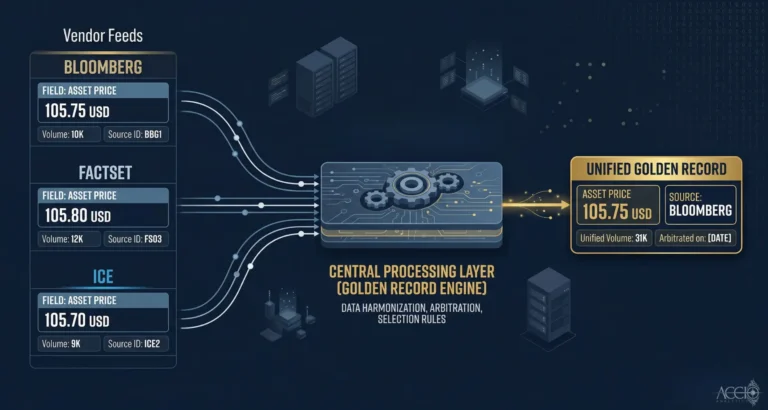
An abstraction layer sits between the vendor feed and your infrastructure. The vendor sends data. The abstraction layer validates, maps, and normalizes it before anything touches the core system. When a vendor changes their schema, the abstraction layer absorbs the change. Your core system does not feel it.
When you want to switch vendors, you reconfigure the abstraction layer. You do not rewrite your integrations.
This is an architectural principle, not a product pitch. The institutions that have this layer can evaluate vendors on merit, not on switching cost. They negotiate from a position of choice, not captivity.
I explore the abstraction layer in more technical detail on Substack, including how deterministic memory works to maintain institutional knowledge across vendor changes.
Byline: By Sean Mentore, Co-Founder & Chief Architect, Accio Analytics
Ready to map your vendor dependencies?
I’m offering a 30-minute technical whiteboard session. No pitch, just architecture. We’ll identify where your lock-in tax is hiding.
Citations
- FINOS/Linux Foundation: 79% of financial services firms use open-source to reduce vendor dependency.