The Golden Record: Building a Single Source of Truth from Multiple Vendor Feeds
Sean Mentore
4 min read
Everyone wants a golden record. A pristine, authoritative record of truth. The single version of every data point that everyone in the organization can trust.
Very few institutions actually have one.
The reason is not a lack of ambition. It is a lack of architecture. Building a golden record requires more than picking a vendor and trusting their data. It requires an ingestion layer that can assemble a composite record from multiple sources, enforce a hierarchical prioritization, and maintain a complete audit trail of where every data point came from.
The Multiple-Truth Problem
Financial institutions typically receive data from multiple vendors. Bloomberg for pricing. FactSet for fundamentals. ICE for fixed income. Each vendor has their own delivery format, their own update schedule, and their own definition of what “correct” looks like.
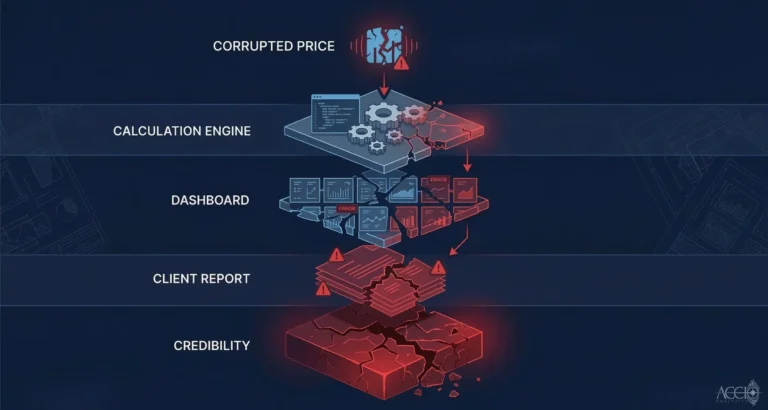
The result is predictable. The portfolio management system uses Bloomberg’s price. The risk system uses FactSet. The client reporting system uses a manual override that someone set up years ago. Three systems, three numbers, one client asking why the report does not match.
Master Data Management research confirms this challenge is pervasive. Financial institutions typically operate dozens, sometimes hundreds, of systems across front, middle, and back office functions. Each system optimized for a specific purpose. Alignment across departments is inherently complex.
What a Golden Record Actually Is
A golden record is not a vendor selection. It is an architectural decision.
You define a hierarchical source prioritization: if Bloomberg has the price, use Bloomberg. If Bloomberg missed it, fall back to FactSet. If FactSet is stale, check ICE. The system takes the best data point from each source to construct a single verified record.
Sometimes the golden record is entirely from one provider. Sometimes it is a composite built from six sources. The system does not care. What matters is that the rules are defined, the rules are enforced, and the output is one record that everyone in the organization uses.

The Audit Trail Imperative
A golden record without an audit trail is just another number.
The critical requirement is lineage. For every data point in the golden record, you need to know: where did it come from? When did it arrive? Was it the primary source or a fallback? Did the ingestion layer make a correction? Was there a manual override? Who approved it?
The ingestion engine can audit and tell you exactly all the pieces of where each data point came from that makes up that golden record. If you ever have an audit or you ever need to go back to it, the lineage is right in front of you.
Regulatory scrutiny on data lineage is increasing. The institutions that can trace every number back to its source will pass audits. The ones that cannot will be explaining why two versions of the same report show different numbers.
Why the Ingestion Layer Matters
You cannot build a golden record on top of an ETL that just loads whatever arrives. The ingestion layer needs to understand source priority. It needs to assemble composite records. It needs to detect when a primary source is missing and fall back to the next source in the hierarchy. It needs to log every decision.
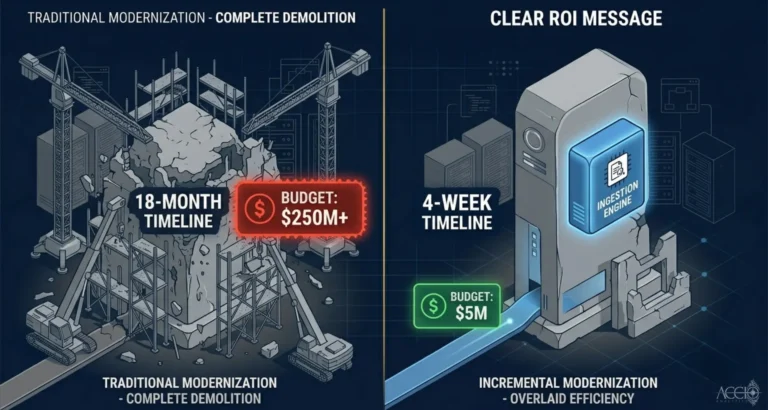
Most institutions are reconciling vendor data manually. Every day. That is the cost of not having an intelligent ingestion layer. The golden record eliminates that manual reconciliation. But only if the ingestion layer is smart enough to build it.
I wrote about the broader data quality problem that makes golden records so difficult in an earlier post. If you have not read it, start there: Why Every Financial Data Problem Is an Ingestion Problem.
Byline: By Sean Mentore, Co-Founder & Chief Architect, Accio Analytics
Reconciling vendor data manually?
I’m offering a 30-minute whiteboard sessions; no pitch, just architecture. We’ll map your current vendor feeds and show you what a golden record would look like for your specific data flows.
Citations
- Master Data Management industry research (LatentView, Gable.ai, Semarchy): Financial institutions operate dozens to hundreds of systems across front, middle, and back office, making alignment inherently complex.
- Survivorship rules in MDM: time-intensive phase of any MDM implementation (Infoverity)